
Capsule Media · Draft for discussion

Magic City
Poker Series

Format & production plan
6 games · 20 episodes · 4 weeks
Seven players, one winner-take-all Sit & Go per week
November 2026
Show intro

A sample of what the introduction could be

Coming soonShow intro
01
The format
One tournament, one week of television
The format

One tournament fills one week of television

7
Players per table
Seven seats and the dealer at the table. Six eliminations carry the story across the week.
1
Winner-take-all Sit & Go
Played start to finish in one sitting on shoot day.
5
Episodes per tournament
Cut into a Monday–Friday week. The winner is revealed on Friday.
20
Episodes delivered
Four weeks on air, from the strongest four of six games shot.
1 tournament
→
MonTueWedThuFri
=
1 week of programming
×4
20 episodes · 4 weeks
30-minute slot = 22 min of show + 8 min of commercials in 3 breaksPlus player interviews and social content captured every shoot day
How one tournament becomes five episodes

Nobody wins until Friday

We shoot the whole game in one day, then tell it across the week. Each episode ends on a cliffhanger so viewers come back the next night.

MonEpisode 1

Meet the seven players. Deep stacks, careful play, first reads and table talk.

Ends onA cliffhanger hand
TueEpisode 2

Blinds start to bite. Rivalries form and the short stacks have to move.

Ends onA big all-in
WedEpisode 3

Big bluffs and all-ins. The middle of the game, where the story turns.

Ends onThe turn in the story
ThuEpisode 4

The pressure builds. Every pot matters and nobody can afford to wait for cards.

Ends onThe hand that sets up Friday
FriEpisode 5

The final hands, and the game is decided.

Ends onThe winner, and the winner interview

The story producer picks each episode's end point around the drama, and interview bites fill around it.

Interviews & testimonials

Interviews are shot mainly for social, while it's fresh

At the table, players just play. A producer grabs each player before the game and right after they bust. Most of it feeds social media and promotion; the episodes use a player's exit and a quick line to camera, plus bites for the recaps and the lead-in to the next episode.

Before the game · stock questions
Every player, same list
One set of questions for all seven, so we can cut between them.
  • Who are you, and how did you start playing?
  • Have you played at Magic City? What makes it memorable?
  • Who at this table worries you?
  • What's your one tell, if you have one?
After · story questions
When they bust, and after the game
The producer works from the hand log, and the answers get cut into the episodes where those hands play.
  • Walk us through the hand that knocked you out
  • Did you suspect anyone was bluffing throughout the game?
  • Who did you think would win, and why?
  • Winner: when did you know it was yours?
Before or after · social questions
Built for vertical clips
Short, punchy answers that work on their own in a feed.
  • Your worst bad beat ever, in one sentence
  • Rate this table's poker faces, 1 to 10
  • Biggest myth about poker players?
  • One rule for playing with friends
On TV: the player introductions in episode 1, plus interview bites and exit interviews that may run through every episode if we decide.
On social and promo: what these interviews are mostly for. Stand-alone clips all week, plus extra footage on hand to promote the series.

Sample questions only, and none of them are final. The Magic City team can send tailored questions of their own.

Every episode, one template

22 minutes of show, three breaks, one clock every night

Every 30-minute slot is 22:00 of show and 8:00 of commercials, in all 20 episodes. Under each bar: the minutes of show before each commercial break, adding up to 22:00.

EPISODE 1 · MONDAY0:45 show open · 2:00 player intros · 0:30 at the table · 1:30 closeOpen0:45Intros2:00Table0:30Act 13:45BREAK2:00Act 24:30BREAK3:00Act 34:30BREAK3:00Act 44:30Close1:30Before the 1st break · 7:00Before the 2nd break · 4:30Before the 3rd break · 4:30After the 3rd break · 6:00EPISODES 2–5 · TUESDAY TO FRIDAY0:30 show open · 1:00 recap · 1:30 close into the next episodeOpen0:30Recap1:00Act 14:00BREAK2:00Act 25:00BREAK3:00Act 35:00BREAK3:00Act 45:00Close1:30Before the 1st break · 5:30Before the 2nd break · 5:00Before the 3rd break · 5:00After the 3rd break · 6:30
Swipe sideways to see the full clock →
Commercial breaks · 8:00
2:00, 3:00, 3:00
After Acts 1, 2 and 3. Each one cuts away mid-hand or on an all-in, so viewers wait through the ads.
Front · Episode 1
Meet the seven players
A 0:45 show open, 2:00 of player intros cut from their stock interviews, then 0:30 of the announcers on the players already seated at the table.
Front · Episodes 2–5
Open + "previously on"
A 0:30 show open, then 1:00 of yesterday's key hands, who went out and where the chip stacks stand.
Close · every episode
1:30
1:15 that builds up the next episode, then a 0:15 show outro. Friday's teases next week's table.
The four actsFeatured hands with card graphicsAnnouncer callInterview bitesEliminations + exit interviewsAct-break cliffhangers
Pacing the game

Two-hour games, with the option to play longer

We plan each game at two hours, 2½ at most, so two games fit easily in a show day. Same 20,000 starting chips and big blind ante; the length of each blind level sets the length of the game.

Time to reach the 4,000 / 8,000 level
8-min levels
88 min
10-min levels
110 min
Our plan
12-min levels
132 min
At most
14-min levels
154 min
Longer option
20-min levels
220 min

Level times run out to 20-minute levels. These are tournament chips, not dollars: 7 players start with 20,000 chips each, so 140,000 chips are in play.

Our plan
Two-hour games, 2½ hours at most
2–2½ hrs
of play
~64–80
hands dealt
~3–4
episodes of strong play
Two games fit easily in a 12-hour show day. Weaker hands and filler round out the five episodes. We're shooting two extra games to ensure quality games are aired.
For your consideration
14-min levels, about 3 hours
~3 hrs
of play
~96
hands dealt
5
full episodes
About 96 hands gives enough strong play for all five episodes, so a longer game may be the better choice. It fills the three-hour slot each game has on a show day.

Estimates assume ~32 hands an hour at a live dealt table, about 30% of hands worth featuring at ~2.5 min of airtime each, and ~7.5 min of non-game content per episode.

02
Social & promotion
Build the audience before Monday, keep it all week
Social media deliverables

About 38 social media pieces for every week that airs

Promoting the series on Magic City's own channels is central: YouTube, TikTok, Facebook and Instagram, with every piece ready in 16:9 and 9:16. Shot on the day by the production team and cut from the interviews and the game.

QtyDeliverableFormatWhen it posts
1Week trailer16:99:16The weekend before the week airs
7Player reveal clips, one per player9:16Before Monday
5Daily episode teasers16:99:16Each day, ahead of air
5Hand of the day, with the card cam view9:16After each episode airs
7+Social-question clips9:16Through the week
6Exit interview clips9:16After that player's episode airs
5Behind the scenes16:99:16Through the week
1Winner reveal + winner interview16:99:16After Friday's episode airs
1Week recap reel16:99:16The weekend after
≈ 38 social media pieces per week≈ 150 across the 4 weeksPlus daily polls and Stories
Promoting each week

Build up TV viewers before Monday, bring them back every night

Before the week
Set the table
  • Week trailer on all channels
  • Player reveals: one player a day in the week before, a short vertical clip with who they are and a line to camera, so viewers have a favorite by Monday
  • Poll: who wins it?
  • Magic City venue feature: the poker room, the set in the event center and the casino floor, with an invitation to come play where the show is made
Airing week · Monday to Friday
One episode a night, three beats a day
Before airTeaser for tonight's episode
After airHand of the day and that night's exit interview
Through the daySocial-question clips, BTS and a poll on who goes out next
After Friday
Crown the winner
  • Winner reveal and winner interview
  • Recap reel of the week
  • Tease next week's table
No spoilers. Nothing that gives away a result goes up before that episode airs.
Every piece in two shapes. 9:16 for Reels, TikTok and Shorts, and 16:9 for YouTube and the web.
03
Production
Six days on site, six games, one controlled set
The 6-day schedule

Two games a day: six games shot for 20 episodes

Day 1
Load-in & setup
Truss, pipe & drape, lighting, cameras, cabling, control room build
Day 2
Tech rehearsal
Table in place, test the card cam shot, graphics, lighting looks, camera presets, a full test game with stand-ins
Day 3
Tournaments 1–2
Two games
Day 4
Tournaments 3–4
Two games
Day 5
Tournaments 5–6
Two extra games, to ensure quality games are aired
Day 6
Load-out
One lead per department strikes and packs, final media check
Setup & rehearsal
Capture · 6 games, the strongest four become 4 weeks of episodes
Strike
Show daysCourtesy breakfast at 8am, official start at 9am, crew lunch at 2pm. Each game is slated for three hours, plus 30 minutes for the winner interview. Each group of players is on site five hours or less.
Every game backed up the same dayEach game is copied to on-site storage and to a backup drive that leaves the venue every night. The DIT works a late shift to offload overnight.
Two extra gamesWe deliver four weeks. We're shooting two extra games to ensure quality games are aired: the strongest four air, and two stay in reserve.
Problems found earlyA full test game on Day 2 shakes out the cameras, table and graphics before Tournament 1.
A show day

Two games a day, and every team runs in parallel

Breakfast at 8am, official start at 9am, crew lunch at 2pm, wrap by 9pm at the latest. Each game is slated for three hours, plus 30 minutes for the winner interview. Each group of players is on site five hours or less.

8am9am10am11am12pm1pm2pm3pm4pm5pm6pm7pm8pmGame unit crewcontrol roomBreakfastPrep forGame 1Game 1 · recordingPrep for Game 2LunchPrep forGame 2Game 2 · recordingPrep for next dayGame 1 playerson site 9am to 2pmHair & makeup,then mic upAt the table · out by 2pmGame 2 playerson site 2:30pm to 7:30pmHair & makeup,then mic upAt the table · out by 7:30pmHair & makeupgreen roomBreakfastGame 1 playersin hair & makeupMeal during the first gameGame 2 playersin hair & makeupInterview unitinterview roomBreakfastGame 1 introsGame 1 exit interviewsWinner interviewLunchGame 2introsGame 2 exit interviewsWinner interviewBTS & socialroaming · 16:9 + 9:16BreakfastArrivals · hair & makeup · behind the scenesLunchBehind the scenes · vertical clips · reactionsDIT / mediacontrol room · arrives at 2pmArrives,first mealOffloads Game 1, then Game 2, within a 12-hour day →
Swipe sideways to see the whole day →
Where everything lives

The full layout of the day, room by room

CARD CAM FEED — CONTROL ROOM ONLYGreen roomPlayers wait hereHair & makeupMic upCoordinatorGear storageCases and sparesPlayer roomPipe & drape set · ~20 × 20 ftControl roomDirector · technical director (switcher)Robotics operator (PTZ cameras) · audio engineerLighting technicianDIT / media manager: offload and drive storageProgram and card cam monitorsInterview room2-camera confessional setIntros · exit interviewsWinner interview1234567Dcamera truss + PTZs◇ tower: 300d softbox + two 80cs · drape uplights8 PTZ +card camsbusted player → exit interviewpeople / camera signalCard cams: that camera feed is never streamed and is only seen inside of the control roomSchematic, not to scale. Final layout depends on the Magic City event center.
Swipe sideways to see every room →
The player room

Robotic cameras, and no crew inside during play
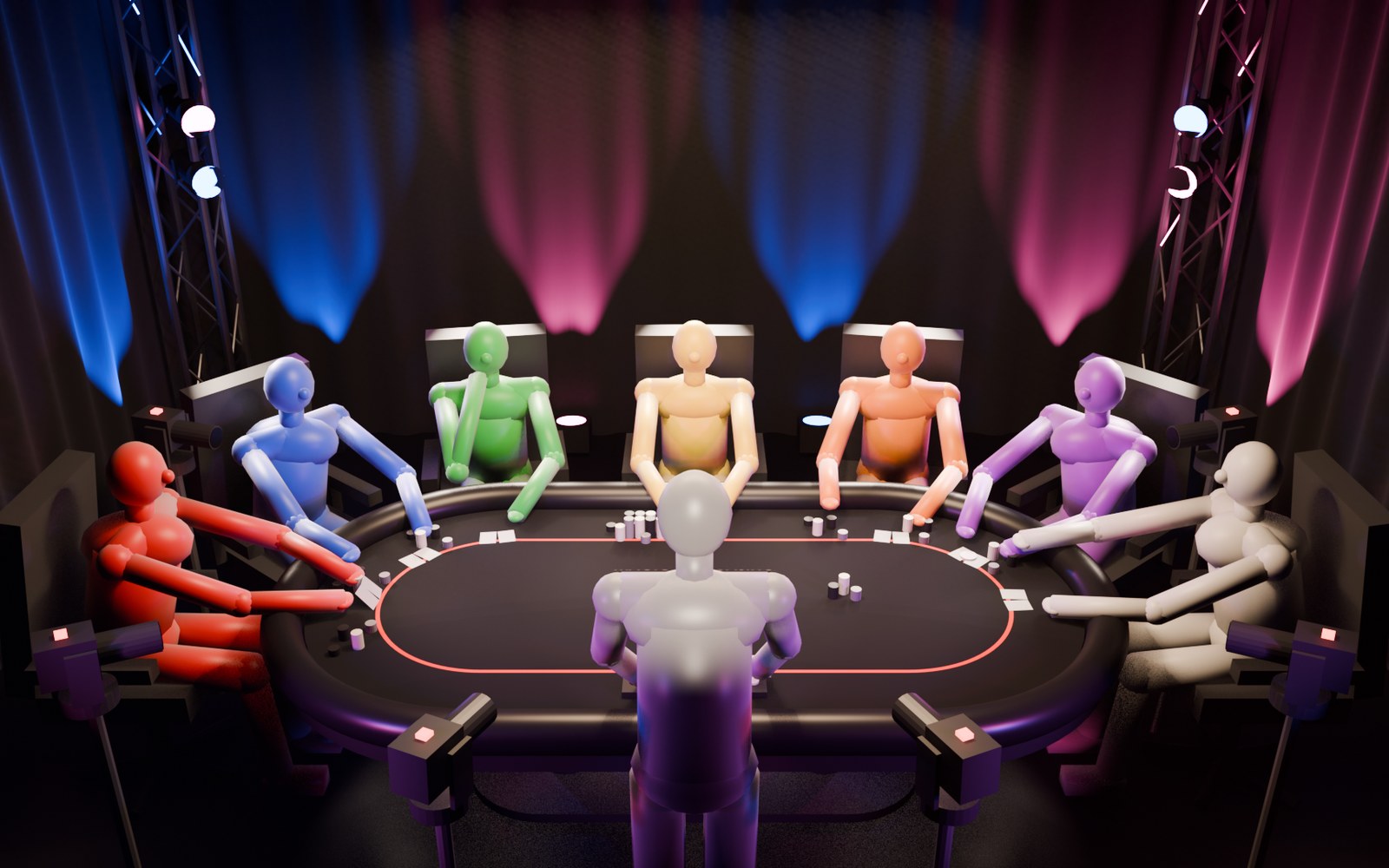
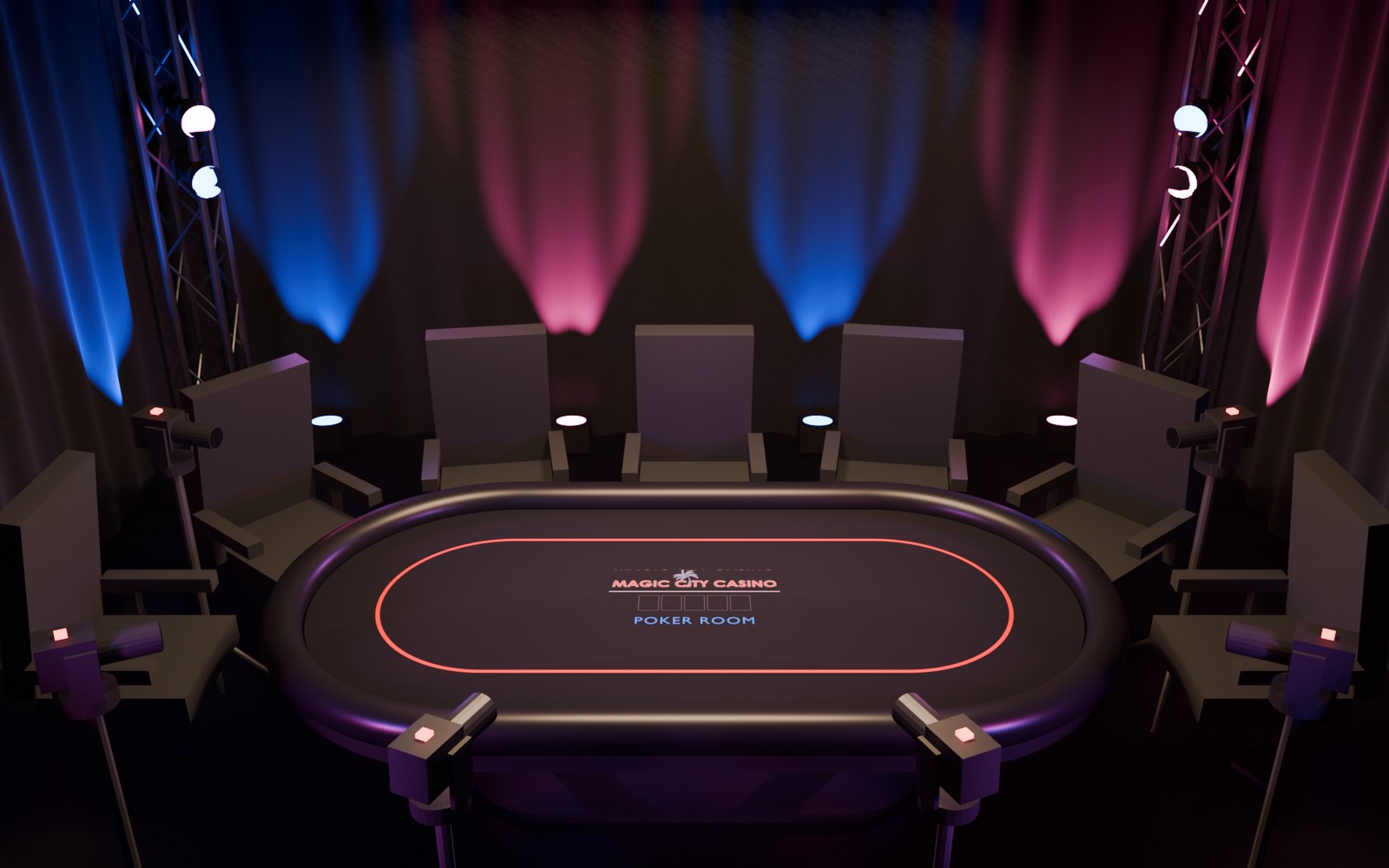
3D blocking of the poker set with the new lighting
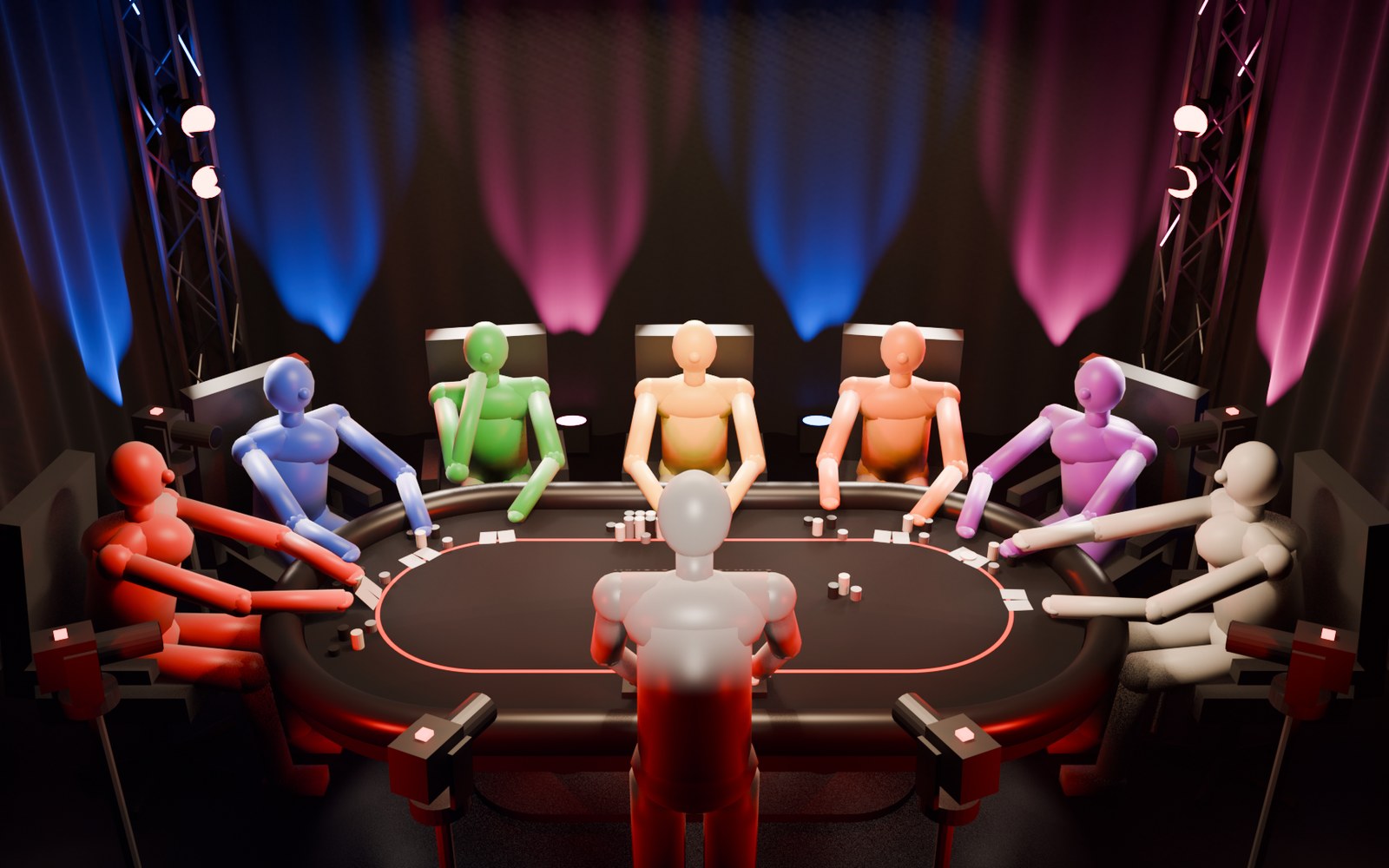
The same wide when a player goes all in
  • Seven-seat table with the dealer at the head
  • Four corner truss towers, each with an Aputure 300d softbox and two Aputure Storm 80c lights
  • Static uplights on the drape in blue and rose. On an all-in, the tower lights push red (right)
  • Center camera truss carrying the overhead PTZs

3D blocking from the updated lighting plan (Nov 11): Aputure Storm 80cs and 300d softboxes, no moving lights. Everything runs from the Aputure app, so there's no lighting board.

AI poker room

The room in motion, before we build it

A spec scene of our set, made with AI: the seven-seat table, the lighting and the on-screen card graphics.

AI poker room0:30
Who's on the crew

One main unit, plus small teams working alongside it

Game unit crew
Control room
  • Director / producer
  • Assistant director / co-producer
  • Technical director (switcher + overhead cameras)
  • Robotics operator (PTZ cameras)
  • Audio engineer
  • DIT / media manager
  • Lighting technician + assistant (show light operators)
Interview unit
Interview room
  • Segment producer (runs the questions)
  • Interview camera operator (2 cameras)
Announcers
Recorded in post production
  • 2 announcers, recorded in a studio after the episodes are edited. Nothing is needed on set.
BTS & social
Roaming · 16:9 + 9:16
  • Behind-the-scenes camera kit with a gimbal, for BTS and vertical social clips
Players
Green room
  • Hair & makeup
  • Player / talent coordinator
  • Production assistant
Table & venue
Provided by Magic City
  • Dealer
  • Tournament director
  • Event center staff & security
  • Card and chip lockup
Game security & assumptions

How we protect the game, and what we're assuming

Game security · run by production
  • Players' cards stay in the control room. Only the control room sees them, and no screen faces the player room. Graphics stay inside the control room too.
  • Card cams: that camera feed is never streamed and is only seen inside of the control room.
  • Players and dealer only inside the drape during play. No phones or devices at the table.
  • Sealed decks, opened on camera. Every deck change is logged.
  • Chip counts on camera at the start and after every elimination.
  • Our own integrity record: every angle recorded start to finish, plus a locked-off wide of the table, since the event center may not have security cameras.
  • Magic City's tournament director rules on disputes, and players sign the house rules before play.
  • NDAs for crew, players and staff, so results stay secret until each episode airs.
Assumptions
  • Venue: the shoot is held in the Magic City event center.
  • Dealer and tournament director provided by Magic City.
  • Cards and chips: Magic City locks up all cards and chips. Their custody is Magic City's responsibility, not production's.
  • Power: enough house power for our gear, with no power drop. Our lighting is all LED and low wattage.
  • Internet (required): a hardline to the control room, or solid Wi-Fi that passes a speed test.
  • Load-in and access for all 6 days.
  • DIT late shift: the DIT offloads media overnight, so their call time is later than everyone else's.
04
RFID card graphics
An option, priced on its own
How RFID works

Every player's cards, on screen as they're dealt

RFID reads every player's cards and puts the cards, win odds, pot and stacks on screen. It is priced on its own, separate from the production budget.

How RFID works1:33
05
Budgets
Download the full budgets
PDF · 14 pages

Client budget

The full production budget, line by line: 6 days on site, 6 games, 20 episodes.

Download PDF
PDF · 1 page

RFID budget

RFID card graphics, priced on their own, separate from the production budget.

Download PDF